 Plastic Surgery
5
Plus Size Mommy Makeover: BMI, Risks & Realistic ResultsPlus size mommy makeover: the BMI surgeons accept, how risk rises with BMI, staged plans, surgery after weight loss and realistic results.
October 3, 2026Read More
What is a mommy makeover? A tummy tuck, breast lift or augmentation and liposuction in one 3–6 hour surgery — what each part does, recovery and risks.
A mommy makeover is a personalised combination of cosmetic surgeries — usually a tummy tuck, a breast lift or augmentation, and liposuction — performed in one operation to restore the shape of a woman's body after pregnancy and breastfeeding. It takes about 3 to 6 hours, and most patients need 2 to 3 weeks off work.
Written and medically reviewed by Op. Dr. Nazım Ramazanov — plastic, reconstructive and aesthetic surgeon, Istanbul (doctor profile) · Last updated: 3 October 2026
What is a mommy makeover — the short answer
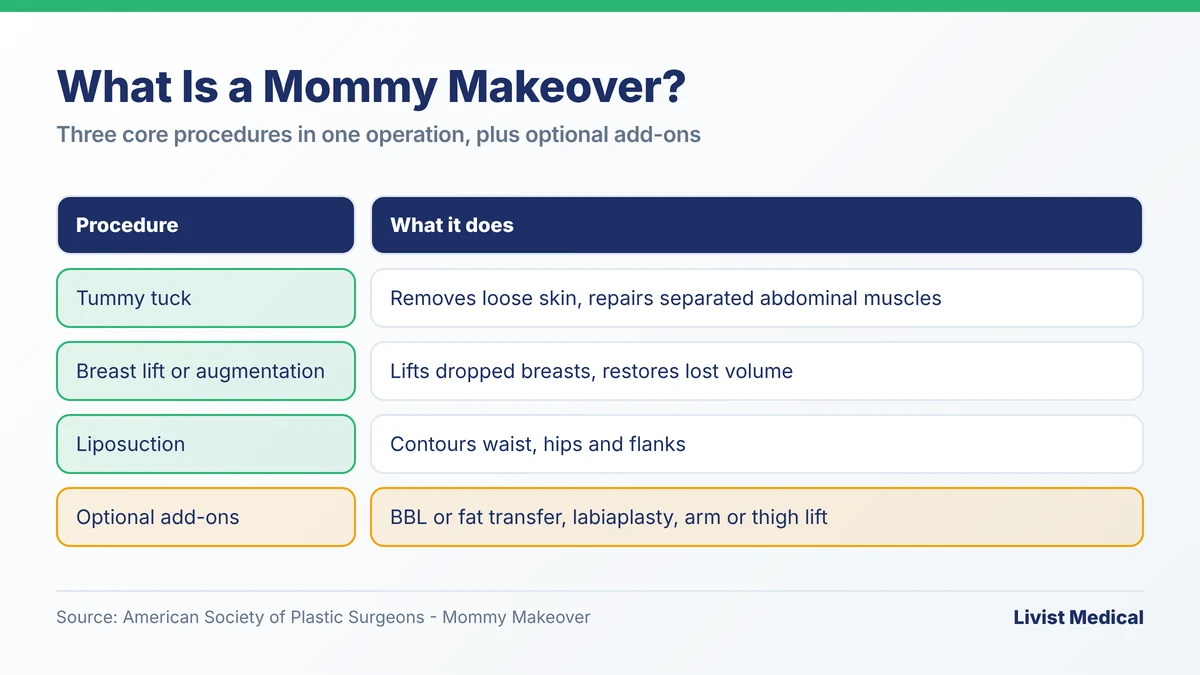
A mommy makeover is a single-stage plan of body and breast surgery designed around the changes pregnancy leaves behind: stretched abdominal skin, separated abdominal muscles (diastasis recti), stubborn fat and breasts that have lost volume or dropped. The American Society of Plastic Surgeons puts the goal this way:
"The goal of a mommy makeover is to restore the shape and appearance of a woman's body after childbearing." — American Society of Plastic Surgeons
That is the practical meaning of the term: "mommy makeover" is a popular name for a group of procedures, not a single operation, and it is not a fixed menu. Two patients can have very different mommy makeovers, which is why prices and recovery times vary so widely.
A mommy makeover typically consists of three procedures performed together: a tummy tuck to remove loose skin and repair the abdominal muscles, breast surgery to restore volume or lift, and liposuction to refine the waist, hips and flanks. The ASPS lists breast augmentation, breast lift, buttock augmentation, labiaplasty, liposuction and tummy tuck as the procedures a mommy makeover may include.
The tummy tuck (abdominoplasty) is the anchor of almost every mommy makeover. It removes excess skin below the belly button, tightens the separated rectus muscles and repositions the navel. Depending on how far the loose skin extends, the surgeon chooses a mini, full, 270° or 360° tummy tuck.
A breast lift (mastopexy) raises and reshapes breasts that have dropped after breastfeeding. If volume is also lost, an implant or fat transfer is added, which is why many plans combine a lift with augmentation. Some women choose a breast reduction instead.
Liposuction contours the flanks, waist, hips, back or thighs so the tightened abdomen blends into the rest of the silhouette. It removes fat cells from the treated area, but it is a contouring tool, not a weight-loss method. A 360° approach treats the whole waistline — see lipo 360 cost and what it involves.
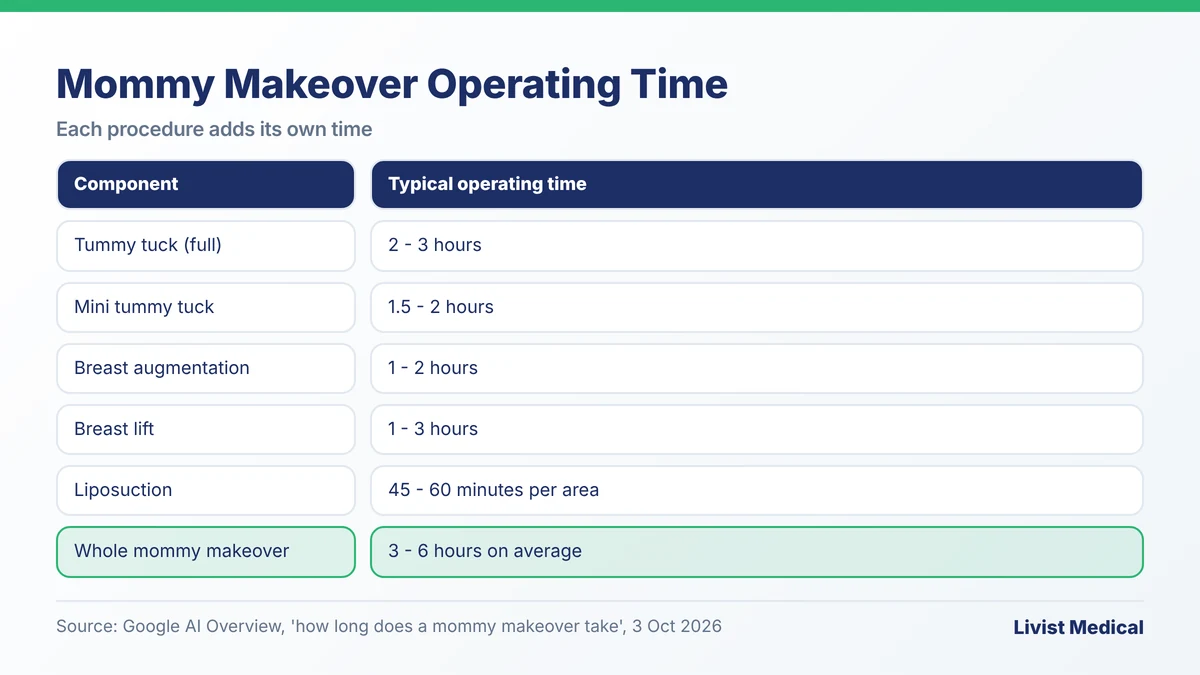
A mommy makeover usually takes 3 to 6 hours of surgery, depending on how many procedures are combined. Each component adds its own time, and if a plan runs beyond about 6 hours, many surgeons recommend splitting it into two operations for safety.
| Mommy makeover component | Typical operating time |
|---|---|
| Tummy tuck (full) | 2 – 3 hours |
| Mini tummy tuck | 1.5 – 2 hours |
| Breast augmentation | 1 – 2 hours |
| Breast lift | 1 – 3 hours |
| Liposuction | 45 – 60 minutes per area |
| Whole mommy makeover | 3 – 6 hours on average |
Times are the ranges Google's AI Overview returns for "how long does a mommy makeover take" (checked 3 October 2026); your surgeon gives the figure for your own plan.
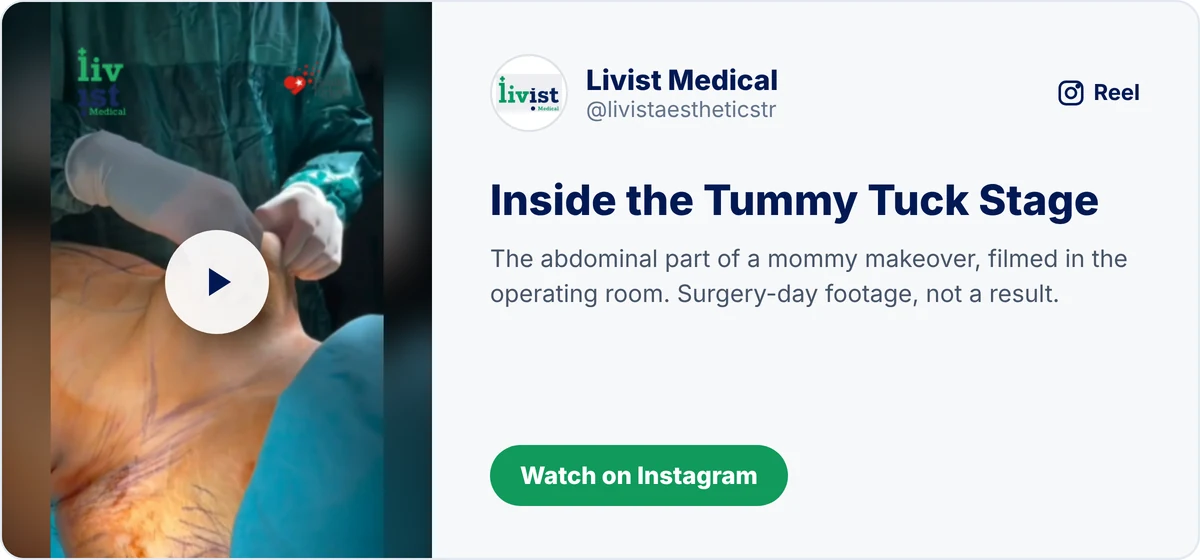
Mommy makeover surgery is performed under general anaesthesia in a hospital. After the operation you wake up with dressings, a support bra and a compression garment around the abdomen; many patients also have thin drains to remove fluid for the first days. The ASPS notes that "A compression garment may also be used to control swelling in the abdomen, waist and buttocks." Most patients stay 1 to 3 nights in hospital before going home or, if they travelled, to a hotel.
A good candidate for a mommy makeover is in good general health, close to a stable goal weight, does not smoke and has finished having children. The ASPS lists these criteria:
A future pregnancy can stretch the repaired muscles and skin again. Many surgeons also ask patients to wait several months after giving birth or stopping breastfeeding so the breasts and weight settle. If you are still losing weight, read how to tighten loose skin after weight loss first.
Most patients take 2 to 3 weeks off work after a mommy makeover, avoid lifting anything heavier than 5 to 10 pounds — including small children — for 6 weeks, and see their final shape between 6 months and a year as swelling resolves. The first week is the hardest, mainly because of the tightened abdominal muscles.
The ASPS cautions that "The final results of mommy makeover surgery may not be apparent for several months after surgery." For a week-by-week view of the abdominal part, see 3 weeks after a tummy tuck.
For a detailed plan with return-to-work, driving and lifting milestones, read mommy makeover recovery time week by week.
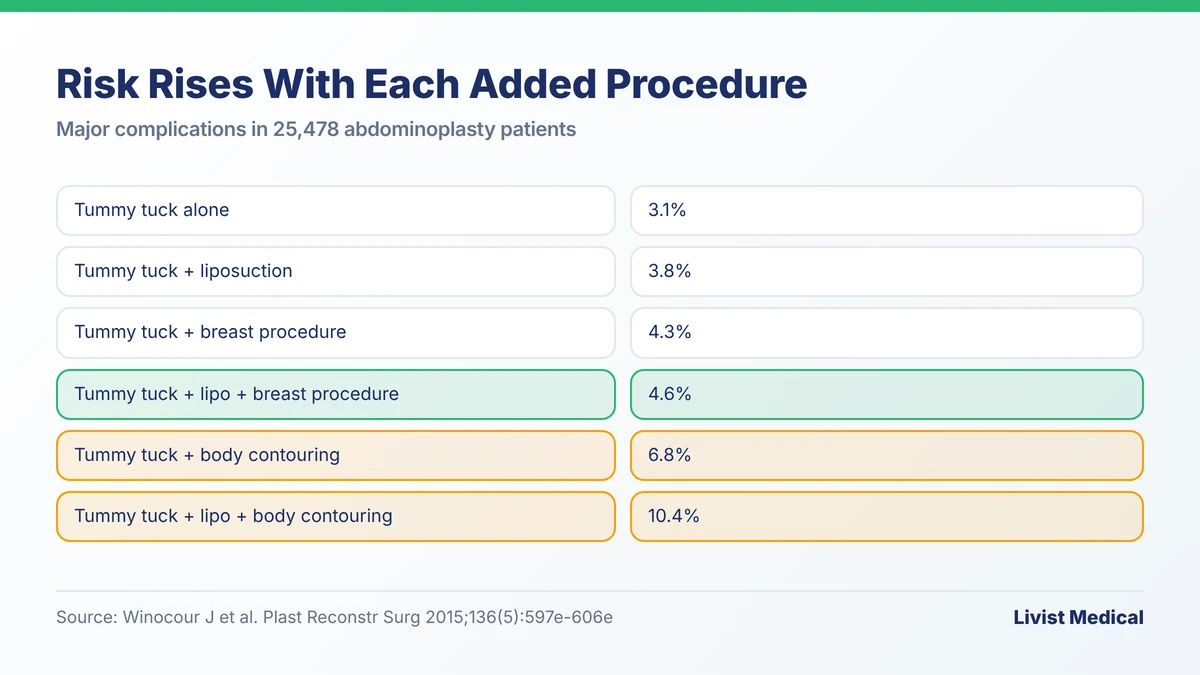
A mommy makeover carries the risks of each procedure plus the risks of a longer anaesthetic. The ASPS lists bleeding, infection, poor healing of incisions, hematoma, seroma, loss of nipple sensation, unfavourable scarring, fat necrosis, deep venous thrombosis, cardiac and pulmonary complications, asymmetry and anaesthesia risks among others. The best data on combined procedures comes from 25,478 abdominoplasty patients:
| Mommy makeover combination | Major complication rate |
|---|---|
| Tummy tuck alone | 3.1% |
| Tummy tuck + liposuction | 3.8% |
| Tummy tuck + breast procedure | 4.3% |
| Tummy tuck + liposuction + breast procedure | 4.6% |
| Tummy tuck + other body contouring | 6.8% |
| Tummy tuck + liposuction + other body contouring | 10.4% |
"Combined procedures can significantly increase complication rates and should be considered carefully in higher risk patients." — Winocour J et al., Plast Reconstr Surg 2015;136(5):597e–606e
Hematoma (31.5%), infection (27.2%) and blood clots (20.2%) made up most of those complications. A smaller 2025 series of 726 patients found no difference in adverse events between mommy makeovers and isolated tummy tucks (Wolf et al., Isr Med Assoc J 2025). Neither study means the surgery is risk-free.
What the published evidence says about deaths and serious complications is covered in mommy makeover death rate: what the evidence shows.
Neither is better in general — the right choice depends on which areas bother you. A tummy tuck treats only the abdomen. A mommy makeover adds breast surgery and liposuction to the same operation, so it addresses the abdomen, breasts and waist with one anaesthetic and one recovery, at the cost of a longer operation and a slightly higher complication rate. If only your stomach has changed, a tummy tuck alone may be enough.
If your changes are mild and sit below the navel, a smaller combination may fit — see mini mommy makeover: cost, what's included and candidates.
Mommy makeover results are long-lasting as long as your weight stays stable and you do not become pregnant again. Fat cells removed by liposuction do not grow back, and the muscle repair is designed to be permanent, but ageing continues. The ASPS notes that implants settle and "the scar lines will improve, although they'll never disappear completely." To see what realistic results look like, read mommy makeover before and after: what the photos show.
A mommy makeover is a combination of surgeries chosen for your body, not a package off a shelf. Livist Medical arranges mommy makeover treatment in Turkey at contracted healthcare institutions holding a Health Tourism Authorization Certificate. Send your photos and history for a free surgical assessment.
Plastic SurgeryPlus size mommy makeover: the BMI surgeons accept, how risk rises with BMI, staged plans, surgery after weight loss and realistic results.
 Plastic Surgery
Mommy makeover scars: where the tummy tuck, belly button, breast and liposuction scars sit, how they fade from week 1 to 2 years, and scar care.
 Plastic Surgery
Mommy makeover with BBL: can you combine them, why many surgeons stage them, fat embolism and clot risks, 360 options, cost and recovery.